Sport Fishing on Maui: Seasons, Target Fish, and Charter Options
In short
Sport fishing on Maui usually means an offshore trolling trip for pelagic fish such as mahi mahi, ono, ahi, and marlin. The best choice depends less on finding a guaranteed catch and more on matching your group, available time, budget, preferred fishing style, and the current weather with the right shared, private, or combo charter.
Table of contents
- Is sport fishing on Maui the right trip for you?
- What fish can you reasonably target?
- What is the best month to fish on Maui?
- Where is the best place to fish on Maui?
- What charter format fits your group?
- How much does it cost to go fishing in Maui?
- What should you check before booking?
- How should you prepare for a Maui sport-fishing trip?
- What else should you know before a Maui fishing trip?
- How do you plan the right trip?
Maui can be a rewarding place to fish because offshore game fish are part of the island's charter scene year-round. But sport fishing is still fishing. The captain can choose the best approach for the conditions, yet no responsible charter can promise a marlin, tuna, mahi mahi, or any other specific catch.
For an overview of trip styles before narrowing the choice, see this guide to sportfishing in Maui.
Is sport fishing on Maui the right trip for you?
Sport fishing on Maui is usually an offshore trolling experience aimed at fast-moving pelagic species, rather than a quiet nearshore reef-fishing outing. Choose it if the group is comfortable spending hours on a moving boat and values a chance at larger game fish over constant action.
On a typical offshore trip, the boat is underway for much of the day with multiple lines trolling behind it. The crew may use lures, bait, or both, then adjust the plan for sea conditions, recent fish activity, trip length, and the anglers' experience. A six- to eight-hour trip gives more time than a short trip, but it still does not turn fishing into a guarantee.
A sport-fishing charter may suit visitors who want to target mahi mahi, ono, ahi, or billfish and do not mind a more open-ocean ride. A bottom-fishing or inshore trip may be the better fit for people who want lighter tackle, a different species mix, or less running offshore. Strike Zone Maui, for example, describes its combo trips as trolling first and bottom fishing later, while its sport trips focus offshore on pelagic fish. Its trip descriptions are a useful example of how those formats differ.
A private charter gives one group control over the boat, while a shared charter places unrelated parties aboard the same trip. That difference often matters more than the name of the boat.
Maui sport fishing is the right choice when your group wants an offshore experience and accepts that the quality of the day is not measured only by the number of fish landed.
What fish can you reasonably target?
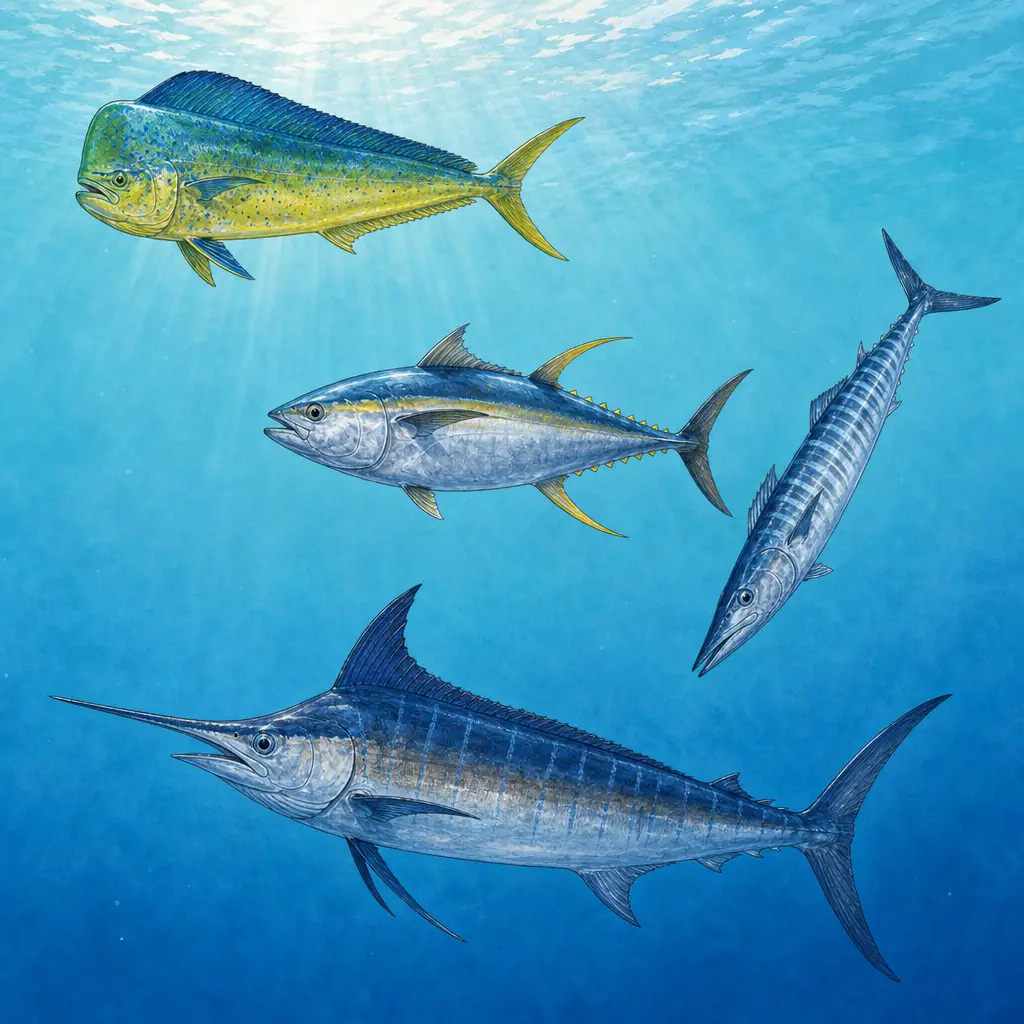
Maui sport-fishing charters commonly pursue pelagic fish including mahi mahi, ono, ahi, striped marlin, blue marlin, and spearfish. The actual target list on a given day depends on conditions and what is being seen offshore, not a fixed menu.
Hawaiʻi's official tourism site identifies marlin, yellowfin tuna or ahi, mahi mahi, and wahoo or ono among the fish visitors may encounter on Maui deep-sea charters. GoHawaii's Maui deep-sea fishing guide also notes that fish can be caught year-round.
- Mahi mahi, also called dorado, are colorful pelagic fish often associated with floating structure and offshore activity.
- Ono, the Hawaiian name for wahoo, are fast fish known for hard strikes and firm white meat.
- Ahi usually means yellowfin tuna in the charter context, although crews may use the name more broadly in conversation.
- Blue and striped marlin are headline catches, but they are not a reasonable promise for any individual trip.
- Nearshore and bottom-fishing species can include trevally, snapper, and other reef-associated fish when the trip type and regulations allow it.
The State of Hawaiʻi regulates some species by size, season, bag limit, location, or method of take. For example, the Division of Aquatic Resources lists Maui-specific limits for some nearshore fish and a five-fish combined daily bag limit for the Deep 7 bottomfish group in noncommercial fishing. Read the current Hawaiʻi marine fishing regulations rather than relying on an old social post or a general fish chart.
The most common fish caught in Maui is not one answer that applies to every charter, because offshore trolling, bottom fishing, and inshore fishing target different water and different species.
What is the best month to fish on Maui?
Maui fishing is available year-round, but May and June are the strongest broad-window recommendation for visitors seeking a mix of marlin, tuna, mahi mahi, and trevally. No month guarantees a specific fish, and weather and offshore conditions can outweigh a seasonal calendar.
GoHawaii calls May through June Maui's golden zone because marlin, tuna, mahi mahi, and trevally are abundant then. That is a helpful starting point for flexible vacation planning, not a promise that every boat will find those fish on a particular morning. The state tourism guide also says Maui fishing is seasonally based and fish can be caught all year.
If your dates are fixed, ask the captain a more useful question than Which fish is in season? Ask what the crew has been seeing in the previous week, how long the boat expects to run, and whether the planned trip is trolling only or combines techniques. A captain who answers specifically is helping you set realistic expectations.
Maui's best fishing month is the month that offers conditions your group can safely enjoy, with a trip style that matches what you actually want from the day.
Where is the best place to fish on Maui?
For visitors booking a sport-fishing charter, the best place to fish on Maui is generally offshore with a captain who can choose the day's workable water, not a fixed public spot. Māʻalaea is a central departure area for South Maui visitors, while West Maui departure availability should be verified directly before booking.
GoHawaii names Māʻalaea Harbor as a charter departure point about 5 to 15 minutes from Kīhei, and it also lists Lāhainā Harbor for West Maui access. However, listings can be stale after the August 8, 2023 Lahaina fire. For example, one currently indexed Start Me Up listing says that operation is unavailable for the foreseeable future because of damage to Lahaina Harbor. Check the charter's actual departure point and check-in instructions instead of assuming a West Maui harbor listing is active. GoHawaii's departure guidance and the Start Me Up availability notice show why both checks matter.
Māʻalaea can be practical for visitors staying in Kīhei, Wailea, Mākena, or central Maui. A departure point farther from your lodging may still make sense if the captain's trip format, vessel, and availability are a better match, but allow enough time for parking and check-in.
The best Maui fishing location is usually the one your captain selects offshore after considering weather, sea state, and current fish activity.
What charter format fits your group?
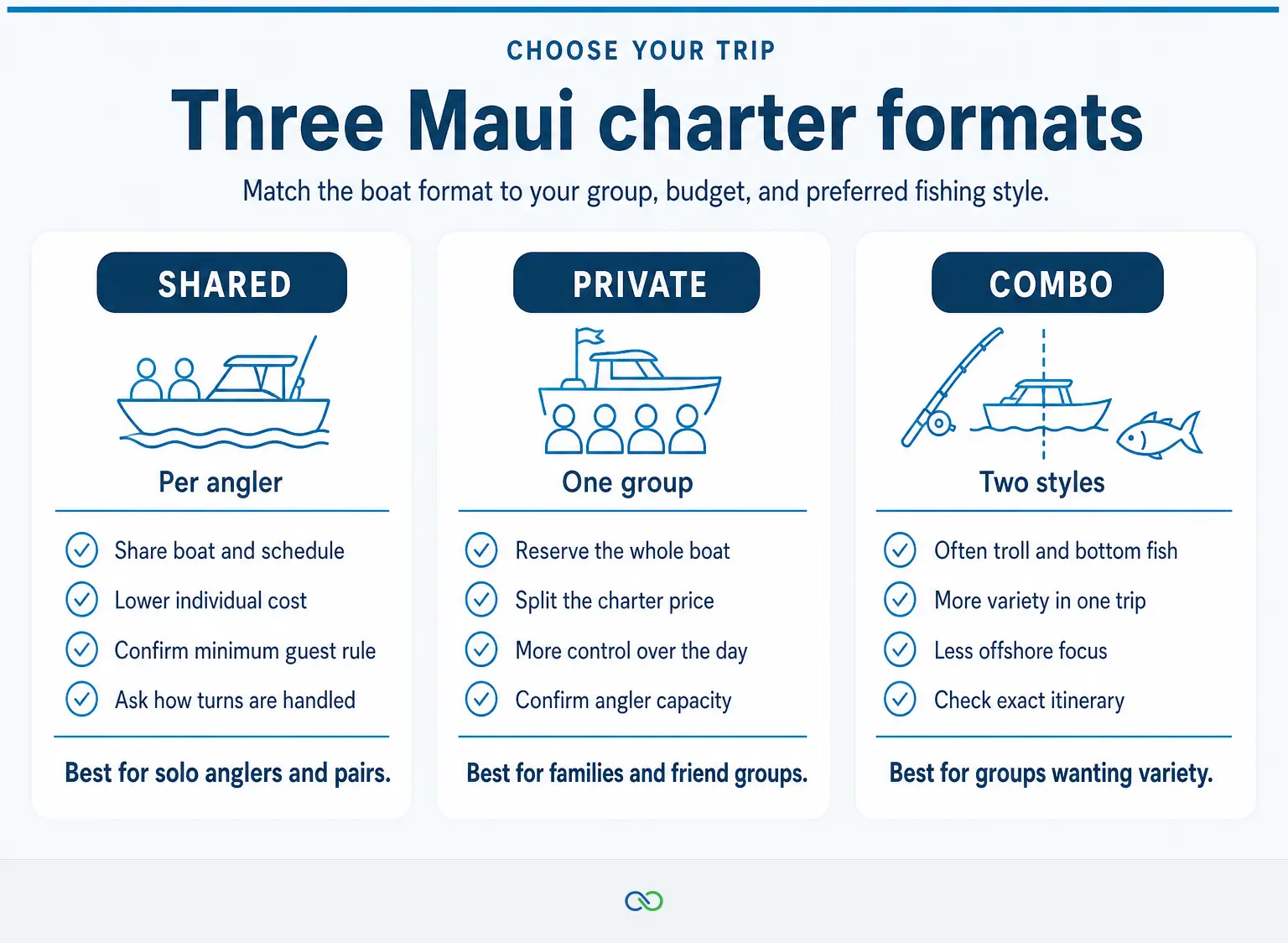
Shared, private, and combo charters solve different problems. Pick the format based on how many people are fishing, how much control you want over the day, and whether everyone is comfortable with an offshore ride.
Shared sport-fishing charters are usually priced per angler. They can lower the individual cost, but you share the boat, the schedule, and the fishing time with people outside your party. Confirm the maximum number of anglers, whether non-fishing riders are allowed, and whether a minimum number of passengers is required for the trip to run.
Private sport-fishing charters reserve the boat for your party. They can work well for families, serious anglers, or groups splitting a charter price. A private trip does not automatically mean every person fishes at once, so ask how many rods are typically worked and how turns are handled when a fish strikes.
Combo charters mix approaches, often trolling for pelagic fish before bottom fishing. They can be a practical choice for a group that wants variety or has first-time anglers, although they do not provide the same offshore focus as a dedicated sport-fishing trip.
Inshore or bottom-fishing trips may be preferable for visitors who want shorter runs, light tackle, or a different pace. They should not be treated as the same product as an offshore trolling charter just because both are called fishing.
The right charter format is the one that makes the boat, fishing style, and cost clear before anyone pays a deposit.
How much does it cost to go fishing in Maui?
Maui sport-fishing prices vary by trip length, whether the boat is shared or private, passenger limits, and what taxes, harbor fees, processing fees, fuel charges, or gratuity are included. Published examples in November 2026 ranged from $280 per angler for a six-hour shared sport trip to $449 per angler for another six-hour shared sport trip, while private six- and eight-hour examples were listed at $1,649 and $1,849.
Strike Zone Maui lists a six-hour shared sport-fishing trip at $280 per adult fisher, with tax included and gratuity excluded. Strike Zone's current trip page also distinguishes fisher and rider prices. UFO Fishing Maui lists a six-hour shared sport-fishing trip at $449, a six-hour private trip at $1,649, and an eight-hour private trip at $1,849. UFO's sport-fishing charter page provides those examples.
These are published operator examples, not an islandwide average or a quote for your trip. Ask for the final checkout total in writing. A lower base fare may not include the same taxes, fees, fuel charge, or tip expectation as another listing.
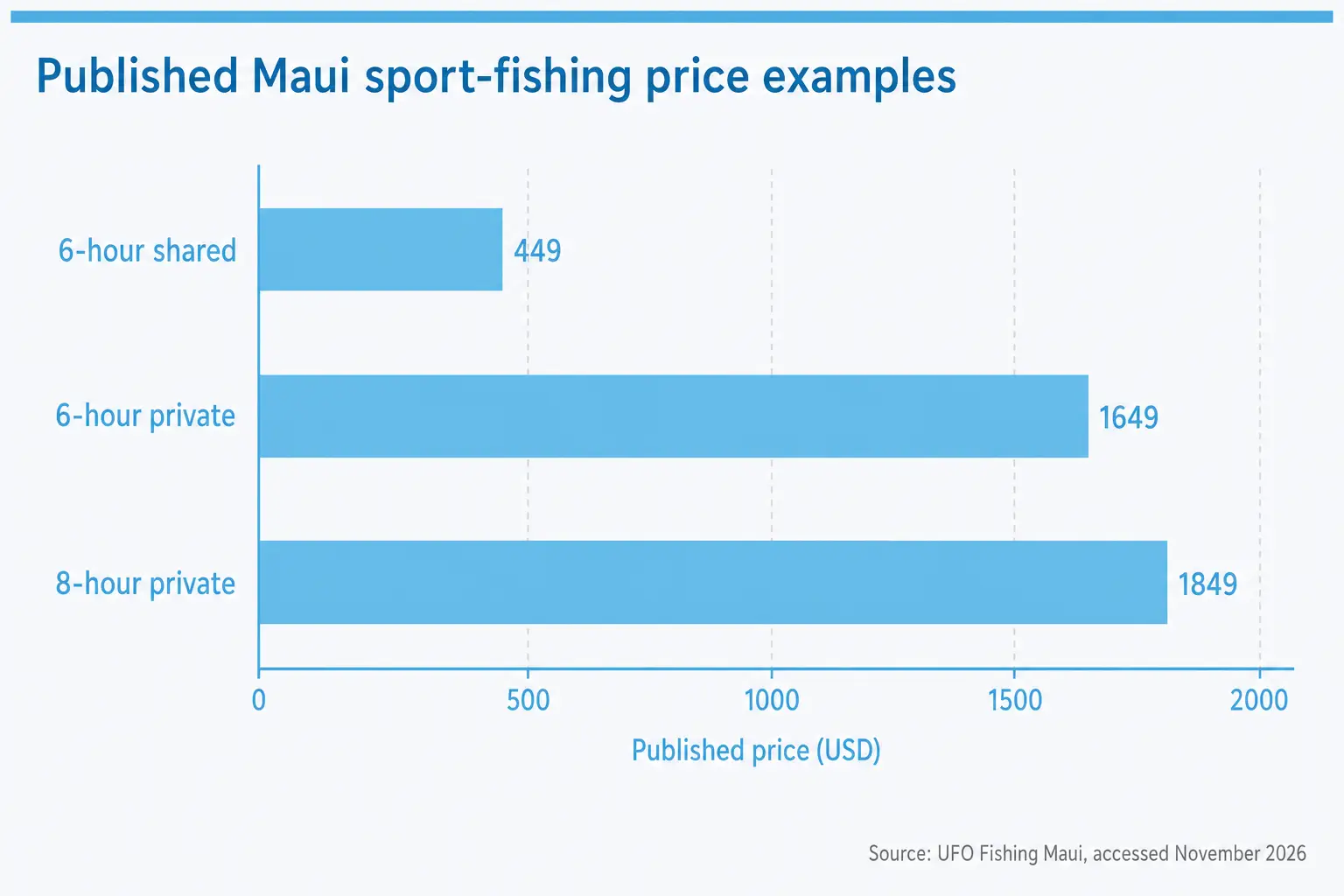
Budget for the charter first, then confirm whether the license, food, drinks, fish cleaning, parking, and gratuity are separate.
What should you check before booking?
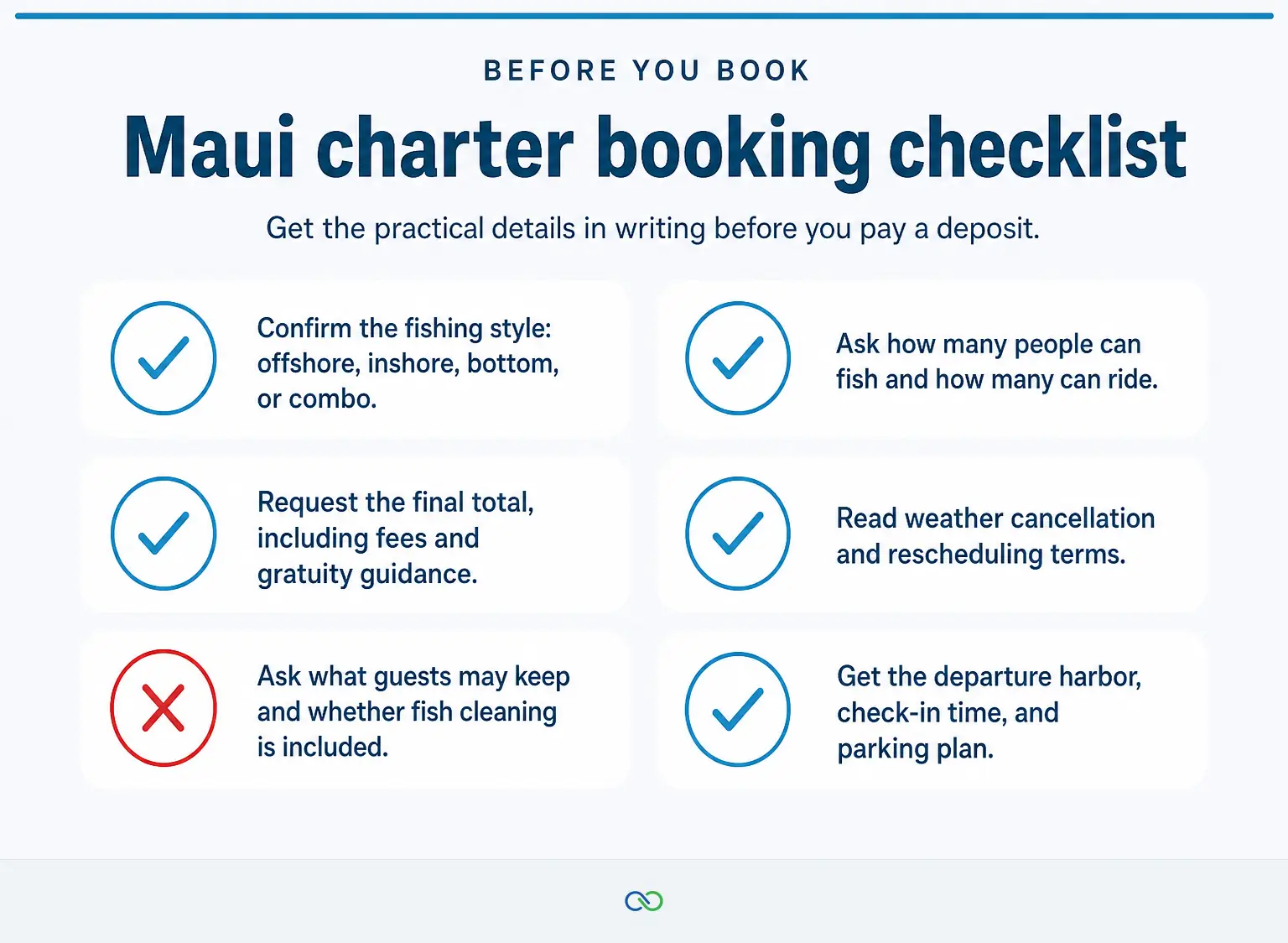
A good charter listing answers basic questions, but a quick direct conversation can prevent the most expensive misunderstandings. Confirm the fishing method, final price, passenger rules, departure location, cancellation policy, and fish policy before putting down a deposit.
Use these questions when comparing Maui sportfishing options:
- Is this offshore trolling, inshore fishing, bottom fishing, or a combo trip? The answer tells you more than a broad sport-fishing label.
- How many people can fish, and how many can ride? Some boats set separate limits for anglers and observers.
- What is the complete price? Ask about tax, harbor charges, fuel surcharges, card fees, cancellation protection, and gratuity.
- What happens if wind or seas make the trip unsafe? Get the weather-cancellation and rescheduling terms before booking.
- What can guests keep, if anything? Policies vary. One operator may provide a portion of the catch while another may offer more, depending on the trip and what is caught.
- Who needs a license? Nonresident anglers age 15 and older need a Hawaiʻi Nonresident Recreational Marine Fishing License for ocean fishing, including fishing from a charter boat, unless an exemption applies. The Hawaiʻi Division of Aquatic Resources lists one-day, seven-day, and annual license prices of $20, $40, and $70. Read the current state license guidance.
Do not rely on a charter webpage that says no license is needed if it conflicts with the current state rule. Hawaiʻi's official regulations take precedence, and the state notes that rules can change.
The best booking question is not What will we catch? It is What exactly is included, what happens if conditions change, and what experience should this group expect?
How should you prepare for a Maui sport-fishing trip?
Prepare for sun, motion, spray, and an early start. Bring what the charter requires, follow the crew's safety briefing, and treat the marine forecast as a real planning factor rather than a last-minute detail.
Most visitors need sun protection, a hat that stays on, polarized sunglasses, water, food if it is not included, and a light layer for a pre-dawn or windy ride. Avoid glass if the operator prohibits it. If anyone is prone to motion sickness, discuss preventive options with a qualified health professional before travel and take any medication as directed.
Check the forecast close to departure. The National Weather Service publishes a dedicated Māʻalaea Bay coastal waters forecast, including wind and sea conditions, but the captain makes the final operational call for the vessel and route. Review seasonal weather and conditions before the trip, and read these practical fishing and boating safety basics if your Maui plans include any time on the water.
Visitors who plan to fish independently rather than with a captain should also review the current Hawaiʻi boating rules and state fishing rules. Charter passengers should listen to the crew, keep clear of lines and hooks, and wait for instructions when a fish is on.
The best preparation is simple: pack for exposure, confirm the license rule, arrive early, and let the captain make the weather call.
What else should you know before a Maui fishing trip?
Visitors often ask about the best month, the best place, cost, and the fish they are most likely to catch. The useful answer to each is a decision rule, not a promise about a specific fish or a single perfect harbor.
What is the best month to fish on Maui?
May and June are a strong all-around window because GoHawaii identifies those months as Maui's golden zone for marlin, tuna, mahi mahi, and trevally. Maui fishing still operates year-round, and the best date for a specific visitor depends on weather, charter availability, and the current offshore bite. Source: GoHawaii.
Where is the best place to fish on Maui?
For charter sport fishing, the best place is offshore water selected by the captain for that day's conditions and fish activity. Māʻalaea is a convenient central departure area for many South Maui visitors, while Lāhainā and other West Maui departures require direct availability checks because harbor operations and operators can change.
How much does it cost to go fishing in Maui?
Published November 2026 examples ranged from $280 per adult for a six-hour shared sport-fishing trip to $449 for another shared six-hour option. Private offshore charters can cost more than $1,600. Compare final totals, not only advertised starting prices, because tax, fees, fuel charges, and gratuity may be treated differently.
What is the most common fish caught in Maui?
There is no single fish that is most common across all Maui fishing trips because sport fishing, inshore fishing, and bottom fishing use different methods and target different water. Offshore charters commonly pursue mahi mahi, ono, ahi, and marlin, while other trip types may focus on reef and bottom species.
A useful Maui fishing plan starts with your group and the type of day you want, then narrows to the boat and captain that can deliver it safely.
How do you plan the right trip?
Start with your preferred fishing style, then compare charter format, duration, departure location, and the true total cost. If your group needs a captained fishing experience, use the Maui Boat Rentals contact page to ask about fishing charter options, then confirm the operator's current departure point, inclusions, and license instructions before booking.
For a deeper planning look at offshore trip logistics, costs, seasons, and target fish, read hawaii deep sea fishing maui, explained.