Best Maui Snorkel Tours: Choose by Destination, Boat, and Trip Style
In short
The best Maui snorkel tour is the one that matches your group’s water comfort, preferred destination, and tolerance for boat time. Start by choosing between Molokini, a coastal reef, or a longer island-crossing trip, then compare shared and private formats, beginner support, and the day’s ocean conditions.
What kind of Maui snorkel tour fits your group?
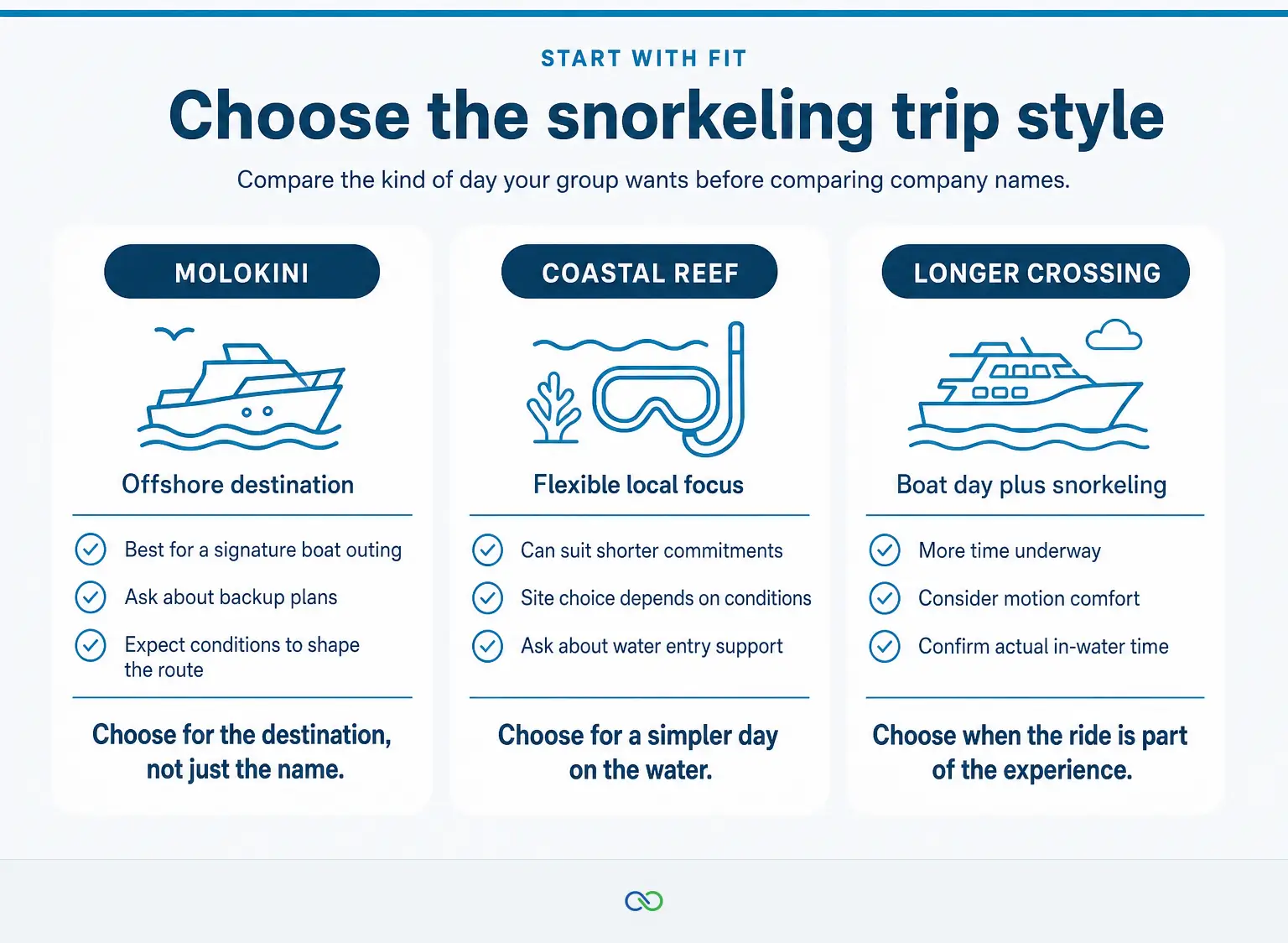
Choose the destination and trip format before comparing company names. A fast boat is not automatically better, and the longest trip is not automatically the best value if your group would rather spend less time in transit and more time comfortably in the water.
A useful first split is the experience you want most: a well-known offshore destination, a flexible coastal reef outing, or a longer day built around the boat ride as well as snorkeling.
| If your group cares most about… | Start by comparing… | Ask before booking |
|---|---|---|
| A signature offshore stop | Molokini-focused tours | What route is planned, how much in-water time is typical, and what happens if conditions change? |
| Less time committed to a crossing | Coastal reef tours | Which site is chosen for the day, and how does the crew decide when conditions are unsuitable? |
| A slower, more private pace | Private trip options | Who is included, what equipment is provided, and how much can the itinerary change? |
| First-time snorkeling | Guided trips with clear beginner support | Is flotation available, is there an in-water orientation, and what swimming ability is expected? |
| A boat-centered day | Longer trips or island-crossing excursions | How much time is spent underway versus snorkeling, and are motion-sensitive guests likely to be comfortable? |
A Maui snorkel tour should fit the least confident person in the group, not only the strongest swimmer. That one choice usually matters more than a boat’s marketing description.
Is it worth it to snorkel at Molokini Crater?
Molokini can be worth it when your group wants an offshore snorkeling destination and is comfortable with a boat-based itinerary. It is not automatically the right choice when someone in the group is anxious about motion, needs a very easy water entry, or would rather stay closer to shore.
The State of Hawaiʻi identifies the Molokini Shoal Marine Life Conservation District as roughly three miles off Maui’s southwest coast. The same state page says commercial activities involving guests entering the water, including snorkeling, require a permit, and it prohibits taking marine life, altering coral, and feeding aquatic organisms. Read the current Molokini Shoal MLCD rules from the Hawaiʻi Division of Aquatic Resources. (dlnr.hawaii.gov)
That protection is a reason to treat Molokini as a place to observe, not touch. It is also a reason to ask practical questions rather than assuming every Molokini outing is identical:
- Does the itinerary focus on Molokini, or is another site used if conditions are not suitable?
- How does the crew brief guests on reef etiquette and water entry?
- Is a flotation device available for guests who want extra support?
- How much of the trip is boat travel compared with time in the water?
- What is the cancellation or rebooking policy if weather changes the plan?
For more context on the destination itself, see this guide to Molokini snorkeling.
Molokini is a good match for travelers who want an offshore destination and accept that the ocean, not the brochure, determines the final route.
Should you choose a shared boat, a private charter, or a self-drive rental?
A shared tour is usually the simplest choice for travelers who want a crew to handle the route, equipment process, and group logistics. A private outing or self-drive rental can offer more control, but it also requires the group to be realistic about boating experience, responsibility, and comfort in open water.
Use these distinctions when comparing your options:
- Shared boat tour: Best for visitors who want a set itinerary, a crew-led schedule, and the convenience of joining other guests. Ask how the operator handles beginners, mobility needs, gear fitting, and changes in conditions.
- Private charter or private boat tour: Best for groups that value privacy, a custom pace, and the ability to focus the outing around their own priorities. Confirm the group limit, what is included, and which decisions remain weather-dependent.
- Self-drive rental: Best only for qualified operators who are comfortable accepting the responsibility of navigation, boat handling, and making conservative decisions around weather and water conditions. It is not a substitute for snorkeling instruction or ocean experience.
The right format is the one that gives your group enough support without paying for a level of structure it does not need.
What should beginners and families look for before booking?
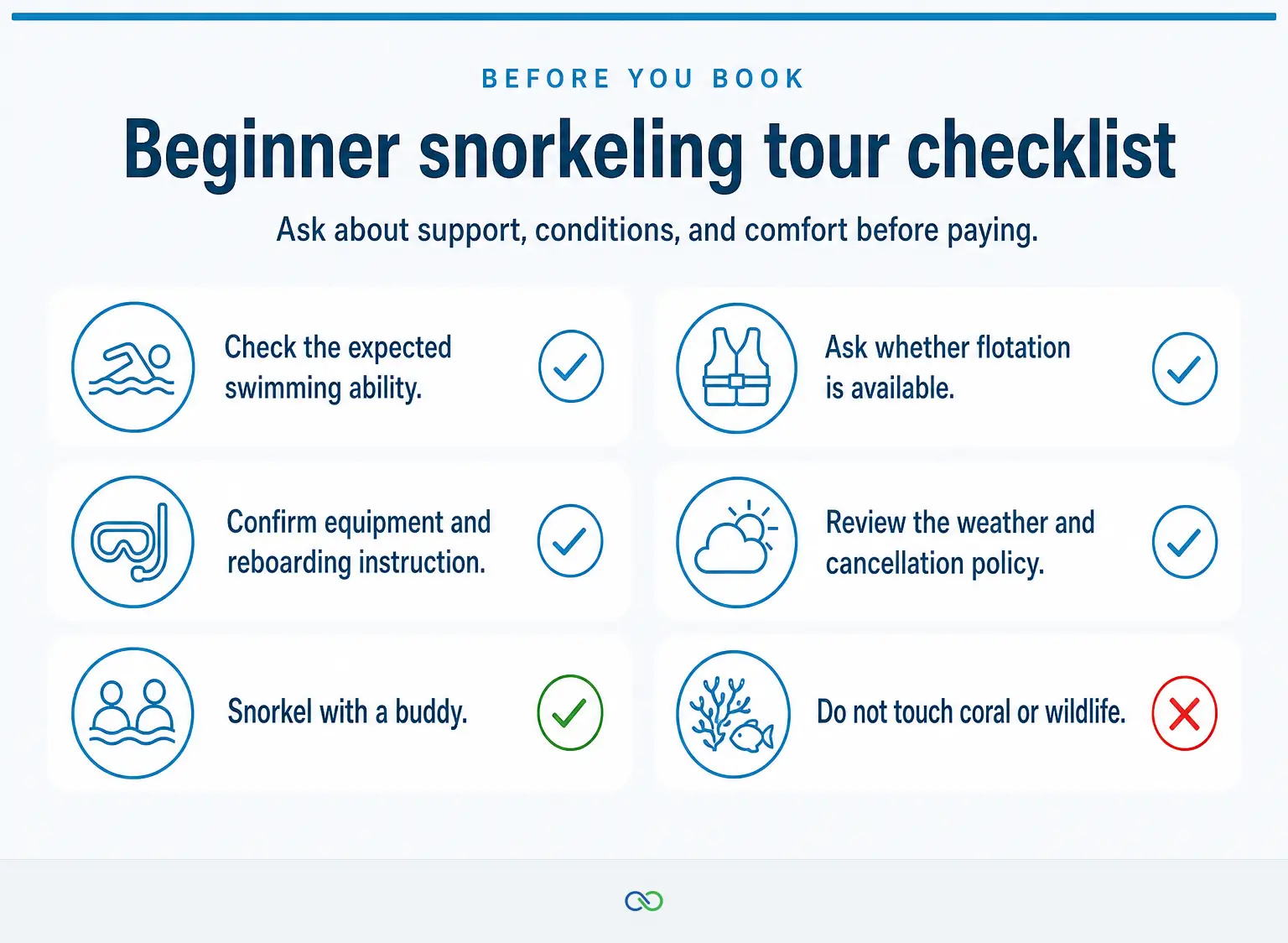
Beginners and families should prioritize clear safety procedures, easy equipment support, and a crew that explains what will happen before anyone gets in the water. A tour can provide structure, but it cannot make unsafe conditions safe or replace basic comfort in the ocean.
Hawaiʻi Ocean Safety advises snorkelers to be experienced ocean swimmers, check conditions before entering, use a buddy system, avoid standing on coral, and stop if they feel dizzy, disoriented, or unwell. Review Hawaiʻi Ocean Safety’s snorkeling guidance before committing to a trip. (oceansafety.hawaii.gov)
Ask these questions before booking:
- What swimming ability does the tour expect from each guest?
- Is flotation equipment available, and is help offered with fitting it?
- Does the crew provide an orientation for masks, snorkels, fins, ladders, and reboarding?
- Is there shade, seating, water, and a restroom if the trip is long enough to need them?
- What is the plan for a guest who decides not to snorkel after reaching the site?
- How does the trip change if wind, waves, visibility, or current make the original plan unsuitable?
For family groups, a shorter and calmer-feeling outing can be a better day than an ambitious itinerary that leaves one person uncomfortable. Choose support and conditions over a crowded list of stops.
How do you compare Maui snorkel tours without relying on a best list?
Compare the same eight details across every tour you are considering. This turns a vague search for the best Maui snorkel tour into a decision based on what your group will actually experience.
| Compare this | Why it changes the trip |
|---|---|
| Destination and backup site | A planned stop may change with wind, waves, current, or visibility. |
| Departure area | Drive time and harbor location affect an early-morning itinerary more than many travelers expect. |
| Total duration and in-water time | A longer excursion does not necessarily mean more snorkeling. |
| Boat layout and ride style | Seating, shade, ladder access, and the feel of the ride can matter to families and motion-sensitive guests. |
| Group size | Smaller groups can feel more personal, while larger boats may have different amenities and schedules. |
| Beginner support | Look for equipment instruction, flotation options, and a clear explanation of water entry and exit. |
| Included items and extra charges | Confirm gear, food, drinks, parking, transportation, gratuities, and photos before you compare prices. |
| Weather and cancellation policy | Read this before paying, not when the forecast changes. |
South Maui travelers may want to compare Wailea snorkeling tours, snorkeling Makena, and this Kihei snorkeling guide alongside a boat tour. These areas can suit different schedules and comfort levels, so location is part of the decision, not an afterthought.
A useful comparison is not about finding one winner. It is about finding the trip whose route, ride, support, and cancellation terms fit your group.
What are common snorkeling hazards in Hawaii?
Common snorkeling hazards in Hawaiʻi include changing surf, currents, waves breaking in shallow water, difficult entries and exits, sharp coral, fatigue, and poor visibility. The safest response is to assess conditions honestly, stay with a buddy, and skip the water when the conditions or your comfort level are wrong.
Hawaiʻi Ocean Safety recommends checking conditions and consulting lifeguards where available. It also warns against snorkeling in high surf, high winds, heavy shorebreak, strong currents, murky water, and near shallow reef or rocky areas where getting upright can be difficult. (oceansafety.hawaii.gov)
Wildlife deserves space too. NOAA Fisheries recommends staying at least 10 feet away from sea turtles in Hawaiʻi, on land and in the water, and says never to touch, chase, or feed marine wildlife. See NOAA’s Hawaiʻi marine wildlife viewing guidelines. (fisheries.noaa.gov)
The safest snorkeling decision is sometimes not to enter the water. Conditions can change faster than an itinerary does.
What questions do travelers still ask before booking?
These common questions have no single answer because ability, conditions, and trip design vary by day. The useful answer is the one that helps a traveler rule out a poor fit before paying.
Where's the best place to snorkel in Hawaii?
There is no single best snorkeling place in Hawaiʻi for every visitor. The right choice depends on ocean conditions, entry and exit difficulty, swimming ability, and whether the group wants a boat ride or shore access. On Maui, compare the day’s conditions before choosing Molokini, a coastal reef, or another destination.
What are common snorkeling hazards in Hawaii?
Common snorkeling hazards in Hawaiʻi include strong currents, high surf, heavy shorebreak, shallow reef, sharp coral, poor visibility, fatigue, and difficult water exits. Hawaiʻi Ocean Safety recommends checking conditions, snorkeling with a buddy, and avoiding the water when wind, waves, or current make the situation unsafe. (oceansafety.hawaii.gov)
Is it worth it to snorkel at Molokini Crater?
Snorkeling at Molokini Crater is worth it for travelers who want an offshore destination and are comfortable with a boat-based outing. It may be a poor fit for guests who dislike boat rides, need an exceptionally easy water entry, or prefer a flexible coastal plan. Confirm the route and weather policy before booking.
Which snorkeling tour company is best in Maui?
No snorkeling tour company is best for every Maui visitor. Compare the destination, departure area, boat setup, group size, beginner support, included equipment, total time, and weather policy. The best fit is the operator whose current itinerary and safety process match the least experienced person in your group.
The best answer to these questions is specific to the day, the water, and the people going with you.
What is the simplest way to choose a Maui snorkel tour?
Pick the destination first, then choose the amount of guidance and boat time your group can genuinely enjoy. Read the weather policy, ask about beginner support, and do not let a low headline price outweigh a poor fit.
Use this checklist while comparing available Maui snorkeling tours so you can book a trip that fits your group rather than someone else’s idea of the best day on the water.